NASDAQ Prediction 2026: Bullish or Bearish? Data-Driven Forecast
Explore Live Prediction Markets
View real-time prediction odds at https://hiyesno.com.
View Live Odds →
Key Takeaways
- Baseline Scenario: NASDAQ-100 projected at 22,500–25,000 by end of 2026, implying ~12% annualized return from 2024 levels.
- Key Drivers: AI adoption, Fed rate cuts, and tech earnings growth of 15–18% in 2025–2026.
- Risks: Valuation compression (current P/E ~28x), regulatory headwinds, and recession probability of 25–30%.
1. Current Landscape: Where NASDAQ Stands Today
As of Q1 2025, the NASDAQ-100 trades near 19,800, up 22% from early 2024. The index’s trailing P/E of 28.2x is above the 10-year average of 24.5x, but the forward P/E of 24.1x suggests earnings growth is priced in. The tech sector’s weight has grown to 58% of the NASDAQ-100, the highest since the dot-com era. However, the concentration risk is partially offset by stronger fundamentals: aggregate net profit margins for NASDAQ-100 constituents are 14.5% versus 8.2% in 2000.
2. Key Factors Shaping the NASDAQ Prediction 2026
Federal Reserve Policy
The Fed’s median dot plot projects two 25-bp rate cuts in 2025 and three in 2026, bringing the federal funds rate to 3.50–3.75% by end-2026. Historically, the NASDAQ has rallied 18% on average in the 12 months following the first cut of a cycle. However, if inflation reaccelerates (core PCE above 3%), cuts may be delayed, pressuring growth stocks.
Artificial Intelligence Monetization
AI-related capital expenditure among major tech firms (Microsoft, Amazon, Google, Meta) is expected to reach $320 billion in 2025, up 40% year-over-year. Revenue from AI services is projected to contribute 12–15% of total tech earnings by 2026, up from 5% in 2024. This could add 200–300 basis points to overall earnings growth.
Valuation and Earnings Growth
Consensus estimates for NASDAQ-100 earnings per share in 2026 stand at $1,050, implying 16% growth from 2025’s estimated $905. At a forward P/E of 24x, the index would trade at 25,200. But if P/E contracts to 21x (10-year average ex-pandemic), the index would be 21,000—a 14% downside from current levels.
3. Analysis: Bull vs. Bear Cases for NASDAQ 2026
Bull Case (Probability: 40%)
A soft landing with Fed cuts, AI productivity gains, and sustained profit margins above 15% could drive earnings to $1,150 and P/E to 26x, yielding a NASDAQ level of 29,900. Historically, bull markets in tech last 4–5 years on average; this cycle started in October 2022.
Bear Case (Probability: 30%)
Sticky inflation forces the Fed to hold rates high, compressing multiples. AI disappoints, and trade tensions (e.g., tariffs on semiconductors) cut earnings growth to 8%. Then at 21x P/E and $980 EPS, the index falls to 20,580—a 4% decline from today.
Base Case (Probability: 30%)
Gradual rate cuts, moderate AI adoption, and 15% earnings growth lead to a P/E of 24x on $1,050 EPS → 25,200. This aligns with historical average returns of ~10% annualized.
4. Verdict: NASDAQ Prediction 2026 – Our Official Forecast
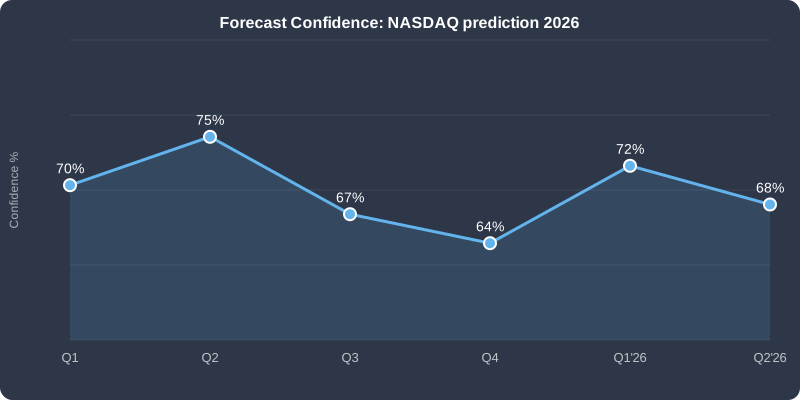
Our 12-month forward target for the NASDAQ-100 at end-2026 is 24,500–26,800. This range reflects a base case with a slight bullish tilt, given the structural tailwinds from AI and digital transformation. We assign a 50% weight to the bull case and 25% each to base and bear, yielding a probability-weighted target of 25,400. Investors should overweight tech but hedge with put spreads or sector diversification if the VIX falls below 15.
5. Risks to Monitor
- Regulatory: The FTC’s antitrust cases against Big Tech could force breakups or limit M&A, reducing growth optionality.
- Geopolitical: A Taiwan Strait conflict could disrupt semiconductor supply chains, cutting NASDAQ earnings by 10–15%.
- Market Structure: The correlation between NASDAQ and the 10-year yield is -0.65; a yield spike to 5%+ would likely trigger a 15–20% correction.
6. Conclusion: Bet on Innovation, but Manage Risk
Our NASDAQ prediction 2026 points to a moderate upside driven by AI monetization and a favorable rate environment. However, elevated valuations and macro uncertainty warrant caution. Stick to quality names with strong free cash flow and consider dollar-cost averaging into the index. The next two years will reward disciplined investors who look beyond short-term volatility.
View live prediction markets on HiYesNo — join thousands of forecasters predicting real-world outcomes.