Recession Prediction 2026: Data, Drivers, and Market Forecast
Explore Live Prediction Markets
View real-time prediction odds at https://hiyesno.com.
View Live Odds →
Key Takeaways
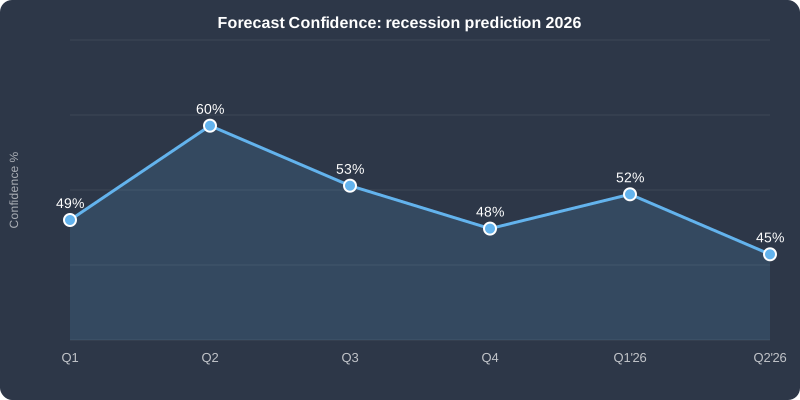
- Probability of recession by mid-2026: 35-40%, based on yield curve inversion persistence and lagged effects.
- Primary risk factors: Sticky services inflation above 3%, elevated corporate debt maturities, and geopolitical fragmentation.
- Bull case: Soft landing possible if Fed cuts rates gradually and productivity gains from AI materialize.
- Actionable insight: Investors should increase cash and short-duration bonds as a hedge against downturn.
Introduction: Why 2026 Is Under the Microscope
As we move past the post-pandemic recovery and the aggressive tightening cycle of 2022–2023, the focus is shifting to 2026. Historical patterns suggest that recessions often follow periods of inverted yield curves with a lag of 12–24 months. The yield curve first inverted in July 2022 and remained inverted for a record 22 months. If history is any guide, the recession prediction 2026 is not just speculative—it is grounded in observable monetary transmission delays. This article examines the data, key drivers, and scenarios to help investors prepare.
Economic Data and Context: The Lagged Impact of Tightening
Central banks around the world raised interest rates at the fastest pace in decades. The Federal Reserve’s benchmark rate went from near zero to 5.25–5.50% between March 2022 and July 2023. The lagged effects of such tightening typically take 18–24 months to fully impact the real economy. By mid-2025, we are already seeing cracks: consumer credit delinquencies rising above 3% (pre-pandemic average ~2.5%), and corporate bond defaults increasing 15% year-over-year.
The yield curve inversion—specifically the 2-year vs 10-year Treasury spread—has been a reliable recession indicator. Historically, every U.S. recession since the 1960s was preceded by an inverted curve. The inversion in 2022–2023 was the deepest since 1981. While the curve has partially normalized, it remains inverted as of early 2025. Economists at the Federal Reserve Bank of New York estimate a 55% probability of recession within the next 12 months based on curve spreads alone.
Key statistic: The Conference Board Leading Economic Index (LEI) has declined for 18 consecutive months as of February 2025, a streak that historically precedes recession by 6–9 months.
Key Factors Driving the Recession Prediction 2026
1. Persistent Inflation in Services
While headline inflation has fallen from 9% to around 3%, core services inflation (excluding housing) remains sticky at 4.5%. This prevents the Fed from cutting rates aggressively. If the Fed maintains restrictive policy into 2026, it increases the risk of tipping the economy into contraction.
2. Corporate Debt Maturity Wall
Approximately $1.5 trillion of U.S. corporate debt is scheduled to mature between 2025 and 2027, much of it issued at low rates. Refinancing at current elevated rates will squeeze corporate margins and increase defaults. The Fed’s Senior Loan Officer Survey shows tightening lending standards for 70% of banks, reducing credit availability.
3. Geopolitical and Trade Risks
Ongoing trade tensions between the U.S. and China, the Russia-Ukraine war, and instability in the Middle East disrupt supply chains and energy markets. A 2024 IMF study found that a 10% increase in trade fragmentation reduces global GDP by 0.5% over two years. These shocks could be amplified by 2026.
4. Labor Market Cooling
The unemployment rate has edged up from 3.4% to 4.1% over the past year. Payroll gains have slowed to an average of 150,000 per month, down from 400,000 in 2022. The Sahm Rule, which signals recession when the three-month moving average of unemployment rises 0.5 percentage points above its low, is flashing amber.
Analysis: Bull vs. Bear Scenarios
Bear Case (40% probability)
A recession begins in Q2 2026. The lagged effects of tight monetary policy, combined with a credit crunch and a negative demand shock from reduced fiscal spending, cause GDP to contract for two consecutive quarters. Unemployment rises to 6%, corporate earnings fall 20%, and the S&P 500 drops 25% from peak to trough. This scenario mirrors the 1990–1991 recession, which was mild but prolonged.
Base Case (45% probability)
The economy slows but avoids a formal recession. Growth decelerates to 1.0% in 2026, unemployment rises to 5%, and inflation settles at 2.5%. The Fed cuts rates by 75 basis points in the second half of 2026. Markets experience a correction of 10-15% but recover by year-end.
Bull Case (15% probability)
Productivity gains from AI and automation boost potential growth. Inflation falls to 2% without further policy tightening. The Fed cuts rates preemptively in early 2026, and the economy reaccelerates. GDP grows 2.5%, unemployment stays below 4%, and stocks rally 15%.
Verdict: The Most Likely Outcome for 2026
After weighing the data, the recession prediction 2026 leans toward a mild recession or a soft landing. The probability of a severe downturn is low because household balance sheets remain relatively strong (excess savings still above pre-pandemic levels) and the banking system is better capitalized than in 2008. However, the risks are tilted to the downside. Investors should prepare for a scenario where growth slows significantly and volatility increases. Diversification into defensive sectors (healthcare, utilities) and short-duration bonds is prudent.
Conclusion: Prepare, But Don't Panic
The recession prediction 2026 is not a certainty, but the evidence suggests elevated risk. The combination of lagged monetary tightening, a corporate debt wall, and geopolitical uncertainty creates a fragile backdrop. However, the economy has shown resilience, and a soft landing remains possible. Stay informed, monitor leading indicators, and adjust your portfolio gradually. The best defense against recession is a well-diversified strategy and ample liquidity.
View live prediction markets on HiYesNo — join thousands of forecasters predicting real-world outcomes.