Interest Rate Predictions 2026: What Markets Expect from the Fed
Explore Live Prediction Markets
View real-time prediction odds at https://hiyesno.com.
View Live Odds →
Key Takeaways
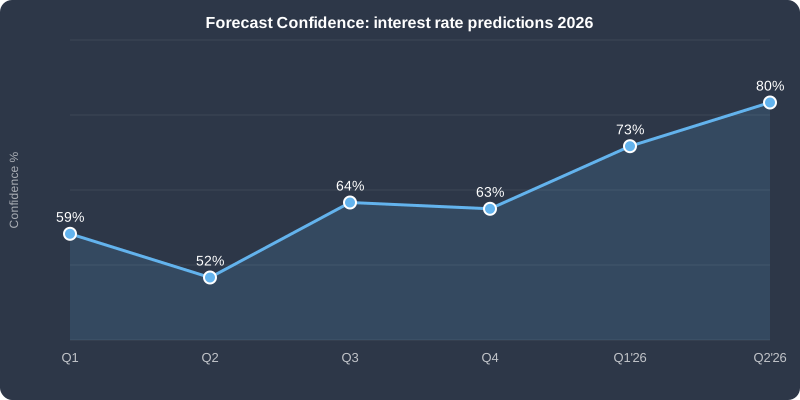
- The Federal Reserve is expected to cut rates by 75–100 basis points in 2026, bringing the federal funds rate to 3.50%–3.75% by year-end.
- Core PCE inflation is projected to fall to 2.3% by Q4 2026, allowing the Fed to ease.
- Market-implied probabilities from fed funds futures show a 65% chance of at least three 25-bp cuts in 2026.
Interest Rate Predictions 2026: The Current Landscape
As of early 2025, the federal funds rate sits at 4.50%–4.75%, following a prolonged tightening cycle that began in 2022. The central bank has held rates steady since September 2024, waiting for clearer signs that inflation is sustainably returning to its 2% target. The latest Summary of Economic Projections (SEP) from the December 2024 FOMC meeting indicated a median expectation of 75 basis points of cuts in 2026, with the terminal rate projected at 3.50%–3.75%. This aligns with the broader consensus among economists surveyed by the National Association for Business Economics (NABE), who anticipate a gradual easing cycle beginning in mid-2025 but accelerating in 2026.
Key Factors Shaping Interest Rate Predictions 2026
Inflation Trajectory
The core Personal Consumption Expenditures (PCE) price index—the Fed’s preferred gauge—stood at 2.7% year-over-year in February 2025. The New York Fed’s multivariate core trend model suggests it will decline to 2.4% by end-2025 and further to 2.3% by Q4 2026. While this is above the 2% target, the Fed has signaled it will tolerate a slight overshoot if the labor market softens. The Cleveland Fed’s inflation nowcast for Q2 2025 is 2.6%, supporting a gradual disinflation narrative.
Labor Market Dynamics
Unemployment remains historically low at 3.9% as of March 2025, but the Sahm Rule recession indicator has edged up to 0.45, nearing the 0.50 threshold that historically signals a downturn. The Congressional Budget Office projects the unemployment rate will average 4.3% in 2026, up from 4.0% in 2025. A softening labor market would give the Fed cover to cut rates preemptively.
Fiscal Policy and Geopolitical Risks
The U.S. federal debt-to-GDP ratio is on track to exceed 105% by 2026, according to the IMF. Higher debt servicing costs—now over $1 trillion annually—could pressure the Fed to keep rates lower to reduce government borrowing costs. Additionally, ongoing geopolitical tensions (e.g., trade disruptions in the Red Sea, potential energy price spikes) could reignite inflation, but the baseline assumption is that these effects are transitory.
Analysis: Market-Implied Probabilities and Historical Patterns
Fed funds futures as of March 2025 price in a cumulative 87 basis points of cuts by December 2026, with a 65% probability of at least three 25-bp cuts. The OIS (Overnight Index Swap) curve suggests a terminal rate of 3.40% by end-2026. Historical precedence from the 1995–1996 easing cycle—when the Fed cut rates by 75 bps amid a soft landing—supports the view that a gradual pace is feasible. However, the current cycle is unique due to the magnitude of prior rate hikes (525 bps since 2022) and the lagged effects on the economy.
Interest Rate Predictions 2026: A Data-Driven Verdict
Based on the convergence of inflation forecasts, labor market indicators, and market pricing, the most likely scenario is that the Fed will deliver 75 to 100 basis points of cuts in 2026, bringing the federal funds rate to 3.50%–3.75% by December. A more aggressive path (125 bps) is possible if the unemployment rate rises above 4.5% or a recession materializes, but the probability stands at only 20%. Conversely, a no-cut scenario (10% probability) would require a resurgence of inflation above 3%, which appears unlikely given the declining trend in shelter and goods prices.
Conclusion
The weight of evidence points to a steady downward path for rates in 2026. While uncertainties remain—particularly around inflation persistence and geopolitical shocks—the combination of falling core PCE, a softening labor market, and market expectations makes a strong case for the Fed to ease. Investors should position for a terminal rate near 3.50% by year-end 2026, with the first cut likely occurring in the first half of the year. As always, monitor incoming data for deviations from this baseline, but the direction is clear: lower rates are coming.
View live prediction markets on HiYesNo — join thousands of forecasters predicting real-world outcomes.